

How to Make Money on Substack in 2026 (Even With a Small Audience)
What to sell first, how the math works, and why you don’t need 10,000 subscribers.

How to Make Money on Substack in 2026
A lot of people start a Substack hoping “one day” it will make money.
Very few ever sit down and do the math.
This isn’t a “manifest your first 10,000 subscribers” article.
It’s a practical guide to how money actually moves through a Substack newsletter in 2026—what you can sell, how much you can realistically earn at different list sizes, and which income streams make the most sense for you right now.
You don’t need millions of views or a monster list.
You need the right offers, in the right order, sold to the right people.
What are the main ways to make money on Substack in 2026?
The short version: Substack is a storefront, not just a blog.
There are six main ways I see creators, coaches, consultants, and solopreneurs earning money from a newsletter in 2026:
Paid subscriptions.
Monthly or annual access to premium posts, audio, or community.Digital products.
Workshops, templates, swipes, mini‑courses, playbooks, or recorded trainings.Services and 1:1 offers.
Coaching, consulting, audits, done‑for‑you implementation.Group programs and cohorts.
Bootcamps, accelerators, masterminds, ongoing group coaching.Affiliate income.
Recommending tools, platforms, or products you genuinely use.Sponsorships and ads.
Paid placements in your newsletter or bundles with other creators.
Most profitable newsletters don’t rely on just one.
They mix 3–6 of these into a portfolio that fits their skills, audience, and available time.
Can you really make money on Substack with a small list?
Yes—if your expectations are rooted in reality and your offers match what your readers already care about.
A “small list” with 200–500 engaged readers can outperform a 5,000‑person list that only treats the newsletter like a diary.
You can’t treat 327 subscribers like an “almost audience” and then be surprised when there’s no money.
Here’s what I’ve seen work at small‑list scale:
Selling services and 1:1 offers first.
Ten people who pay you $300 is $3,000. That’s easier to hit than 300 people paying you $10.Shipping tiny, specific products instead of giant, vague ones.
A 90‑minute workshop or a swipe file that solves one painful problem will convert faster than a 40‑module mega course.Talking about your paid offers like they’re the logical next step—not a random interruption between essays.
“If you want help implementing this in your business, here’s how we can work together.”
The mistake small‑list creators make is waiting until they hit some magical subscriber number to sell.
The money is in being useful to the people already on the list.
How much money can you make from Substack at different list sizes?
You can’t control the exact numbers, but you can understand the ranges.
Think in terms of revenue per subscriber per year instead of “one big launch that saves me.”
Here’s a simple way to look at it:
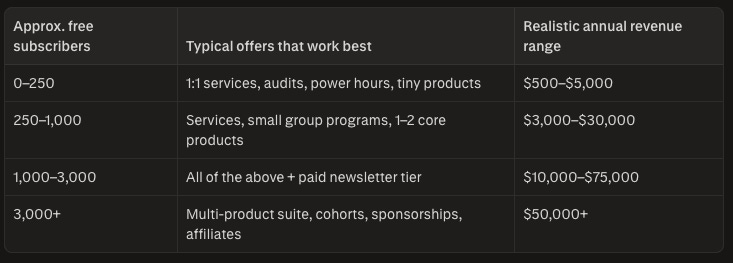
These are not guarantees; they’re sanity ranges.
What matters is:
Your offer mix (what you’re selling).
Your pricing.
How often you give people clear, confident chances to buy.
A quiet list with no offers will under‑earn at every size.
A smaller list with smart offers and clear messages can easily sit at the top of these ranges.
Which Substack income stream should you start with?
Most people start with the hardest one: paid subscriptions.
They set a price, put up a paywall, and then wonder why no one rushes in.
Paid subscriptions work best once:
People already understand your point of view.
You’ve proven you can help them with something specific.
You’ve built a habit of showing up.
For most readers of this article, the better starting point is:
If you’re a coach/consultant/service provider:
Start with 1:1 services or a simple, outcomes‑driven package that extends what you’re already teaching in your free posts.If you’re a creator/educator:
Start with one flagship workshop or a focused digital product that solves a problem you’ve written about repeatedly.
Paid subscriptions then become:
A way to deepen the relationship with people who have already bought from you.
A “front door” for people who aren’t ready for higher‑ticket offers yet.
You’re not “less legit” if your first money comes from services or products instead of a paywalled newsletter.
You’re just building your business in the order that gets you paid faster.
What does a 4–6 income‑stream “portfolio business” look like?
Think of your newsletter as the hub of a portfolio business—not the business itself.
A healthy newsletter‑driven portfolio business often looks something like this:
A free newsletter that grows the audience and builds trust.
A paid newsletter with deeper training, behind‑the‑scenes, or implementation help.
1–2 digital products (swipe files, workshops, templates) that people can buy anytime.
1–2 live offers (group programs, bootcamps, intensives) that run a few times per year.
A services layer (audits, strategy, implementation) for people who want speed and direct help.
Optional: sponsorships and affiliates once you have traffic and trust.
Not everyone needs all six.
But you do need more than one if you want stable income instead of a single fragile revenue stream.
The goal is not “never work again”—it’s “become the kind of creator whose income doesn’t disappear if one offer slows down.”
How long does it take to make money on Substack?
If you only post and never make an offer, you can write for years and earn nothing.
If you’re strategic about it, you can see the first meaningful revenue in 90 days and build a substantial portfolio business with multiple income streams in 12–18 months.
Here’s a rough timeline I’ve seen over and over:
First 90 days
Grow to 100–300 subscribers.
Publish consistently (weekly or twice weekly).
Launch your first tiny paid offer (service, workshop, or digital product), even if your list feels “too small.”
Months 3–9
Refine your message and audience.
Introduce a second income stream (another digital product, a masterclass, small group program, or paid newsletter tier).
Dial in a repeatable way you invite people to buy—without disappearing into a launch tunnel.
Months 9–18
Layer in additional offers as demand and capacity allow.
Ruthlessly kill offers that drain you or don’t sell.
Focus on making the whole system more efficient instead of chasing new shiny revenue ideas every month.
Most people underestimate how much they can do in a focused 12–18 months and overestimate what they can do in 3 frantic weeks.
You don’t need to build every income stream right now—you need to build the next one well, then the next.
What should coaches, consultants, and service providers sell first on Substack?
If you already have a skill you get paid for off‑platform, Substack is not your “new business.”
It’s your distribution and conversion engine.
For you, the fastest monetization path usually looks like:
Clarify one primary outcome you help people get.
Not “better marketing.”
Think “book more qualified sales calls,” “launch your first paid offer,” or “land your first consulting client.”Package that outcome into a simple offer.
A 60–90 minute power hour.
A short, structured 4‑week sprint.
A one‑time audit with written recommendations.
Talk about that offer regularly in your newsletter.
Tell stories, share mini case studies, answer objections, and remind people exactly how they can raise their hand.Only then worry about a paid tier or bigger programs.
Let your newsletter send you the right clients before you ask it to carry your entire business.
Substack becomes the place where your best leads hang out and get warmed up—long before they ever click “book a call.”
What mistakes prevent Substack newsletters from making money?
Most struggling newsletters are structured in a way that guarantees they’ll be exhausting and unpaid.
The most common mistakes I see:
Publishing without a point.
Every post is a one‑off essay instead of part of a clear business narrative.Waiting for a huge audience before selling anything.
If you won’t sell to 127 people, you won’t magically become confident at 12,700.Overbuilding offers.
Months spent designing massive courses and ecosystems that never launch.Putting paid tiers in place of a real offer strategy.
“I’ll just turn on paid and hope people upgrade” is not a strategy.Hiding the ask.
Soft mentions, vague CTAs, or apologizing every time you mention a price.
You need a clear path for your reader to go from “this is helpful” to “this changed my business, and I’m happy to pay for more.”
Carrie Loranger is a Substack strategist who helps creators and solopreneurs grow on Substack and turn one newsletter into multiple income streams.
Ready to build your newsletter business empire?
Reading about income streams is one thing.
Rewiring your newsletter into a business that pays you every month is another.
If you want to:
Map out which income streams make sense for you (and which you can ignore).
Decide what to sell first based on your current list size and time.
Put offers, pricing, and a simple launch plan in place without burning your existing audience…
Then here are a few ways I can support you:
Creator Cashflow Club
My paid membership for builders who want systems, not scattered tips. You get my templates, behind‑the‑scenes breakdowns, and ongoing support so Substack becomes a predictable part of your income instead of guesswork.
→ https://thrivewithcarrie.substack.com/subscribeSubstack Setup Sprint
A focused sprint to get your Substack set up (or cleaned up) the right way: positioning, homepage, sections, offers, and a simple plan for growth. Ideal if you’re ready to treat Substack like business infrastructure, not “just a newsletter.”
→ https://carrieloranger.com/setup-sprint60‑Minute Clarity Call
A 1:1 call to untangle your Substack strategy: what you should write about, who it’s for, how it fits your business, and what to do next. You leave with a clear direction instead of ten competing ideas.
→ https://clarity.carrieloranger.com/60min-clarity-call-pageSubstack Newsletter Audit
A detailed audit of your publication, homepage, welcome flow, and recent posts. I’ll show you what’s costing you subscribers and revenue, and give you specific fixes you can implement right away.
→ https://carrieloranger.com/substack-audit
Good Reads
If you want to go deeper on pieces I mentioned in this guide, start here:


Portfolio Business Newsletter FAQ
https://thrivewithcarrie.substack.com/p/portfolio-business-newsletter-faq
great write-up
Thank you for the valuable and useful information to the platform's subscribers.