

OpenAI Just Opened Its Ad Platform to Everyone — and Google Wrote the New Discovery Rules
OpenAI launches a self-serve ChatGPT Ads Manager, Google publishes its agent-friendly site checklist, Meta posts a first-ever DAU decline, and Anthropic strikes a SpaceX compute deal to lift Claude li

The Big Story: The AI Commerce Layer Just Officially Opened — and Most Creators Aren’t Ready
🎧 The newsletter gives you the news, the podcast audio walks you through an in-depth analysis of what it means for your creator business and the exact moves to make in the next seven days.
On May 5, OpenAI flipped the switch. Its self-serve ChatGPT Ads Manager went into open beta in the U.S., the $50,000 minimum spend was scrapped, and the platform now welcomes any business that wants to run ads inside ChatGPT — SMBs, startups, and the big agency holdcos. Two days later, the pilot expanded internationally to the U.K., Japan, South Korea, Brazil, and Mexico. Six weeks in, the program already hit a $100M annualized run rate, and OpenAI is targeting $2.5B in ad revenue this year and $100B by 2030 (Axios).
That’s one half of the shift. The other half came from Google. Their agent-friendly websites guidance is now circulating broadly — a checklist of how to build sites that AI agents can actually navigate, click, and transact on. Semantic HTML over styled divs. Stable layouts. Visible state changes after every click. No transparent overlays. Buttons bigger than 8 square pixels.
Here is what I think this really means for your business: a parallel internet just got built underneath your old one. Humans still browse, but agents are starting to do the buying — and they shop where they can read, click, and convert. If your creator site is a Squarespace template with hover states that don’t fire and a CTA that’s a styled <div>, you are about to become invisible to the fastest-growing buyer category on the internet. And inside ChatGPT itself, the brands paying for placement just got a self-serve dashboard and a CPA bidding model on the way. The discovery game is no longer just SEO and social. It is “are you parseable, payable, and present in the answer.”
If you sell digital products, run an offer, or take bookings, audit your site this month against Google’s agent checklist. Then decide whether ChatGPT Ads is worth $500 to test on your highest-intent keyword. Six months from now, this is going to feel like the week ad inventory on Facebook opened up to small businesses in 2008 — and the people who tested early built moats while everyone else was still calling it a fad.

Other Things Worth Knowing
Meta posted its first-ever quarter-over-quarter DAU decline. Family Daily Active People dropped to 3.56 billion in Q1 2026, down sequentially from 3.58B (Social Media Today). Meta blamed internet disruptions in Iran and Russia’s WhatsApp restrictions. Revenue still climbed 33% year over year to $56.31B, with ad impressions up 19% and price-per-ad up 12%. Translation for solo creators: the platform is monetizing harder per impression even as growth flattens. Expect more aggressive ad density, lower organic reach, and steeper acquisition costs on Instagram and Facebook through the rest of 2026. If your business depends on free Meta traffic, this is the year to diversify.
X rebuilt its ad platform with AI — and rolled out XChat for iOS. The X Ads Manager overhaul hit on April 30 with AI-driven targeting and automation, while XChat began global rollout to iOS users. After two years of advertiser exodus, X is making a real play to win them back. For creators with X audiences, the practical read: organic reach should improve as the algorithm gets retuned for ad performance, but expect more sponsored content showing up next to yours.
Anthropic struck a compute deal with SpaceX and raised Claude limits. On May 6, Anthropic announced higher usage limits across Claude Code and the Claude API, funded by a new SpaceX compute partnership. If you have been hitting the wall on Claude Code projects or running into rate limits on long context tasks, those caps just got more generous. Worth re-testing whatever workflow you parked because of throttling.
What This Means for Your Business
The pattern this week is sharp. The discovery layer is splitting in two — humans still scrolling on Meta and YouTube, agents now searching, parsing, and buying inside ChatGPT and other LLMs. Meta’s DAU number says the human side is no longer infinitely expandable. OpenAI’s ad rollout says the agent side is now an actual marketplace. And Google’s checklist tells you exactly how to make sure both can find you.
The play this week: pick one page on your site that matters — your offer page, your booking page, your lead magnet — and rebuild it to the agent checklist. Use real <button> and <a> elements. Make sure your “Buy” button is visible from the page heading alone. Add structured data that mirrors what is on the page. Then go test it: ask ChatGPT to find your offer and complete a hypothetical purchase. If it can’t, your future buyers can’t either.
On My Radar
This week I’m watching podcast monetization re-architecting itself around commerce, not ads. Amazon’s “monetize everything” podcast strategy, reported on April 26, is the clearest tell.
The Kelce brothers’ “New Heights” now has a Kelce Clubhouse on Amazon — merch, the Kelce documentary, recommended products for a football-watching party, all bundled into the listening experience. This is not a podcast with ads. This is a podcast as a storefront.
The undercurrent for solo creators: the next round of podcast money is not going to come from a CPM rate. It is going to come from product attached to your show. A template pack tied to the episode. A book club. A toolkit. A community. If you are running a podcast with even a thousand engaged listeners, the question to start asking is not “how do I get sponsors?” — it is “what should my listeners be able to buy when they finish this episode?”
Keep your publishing streak intact
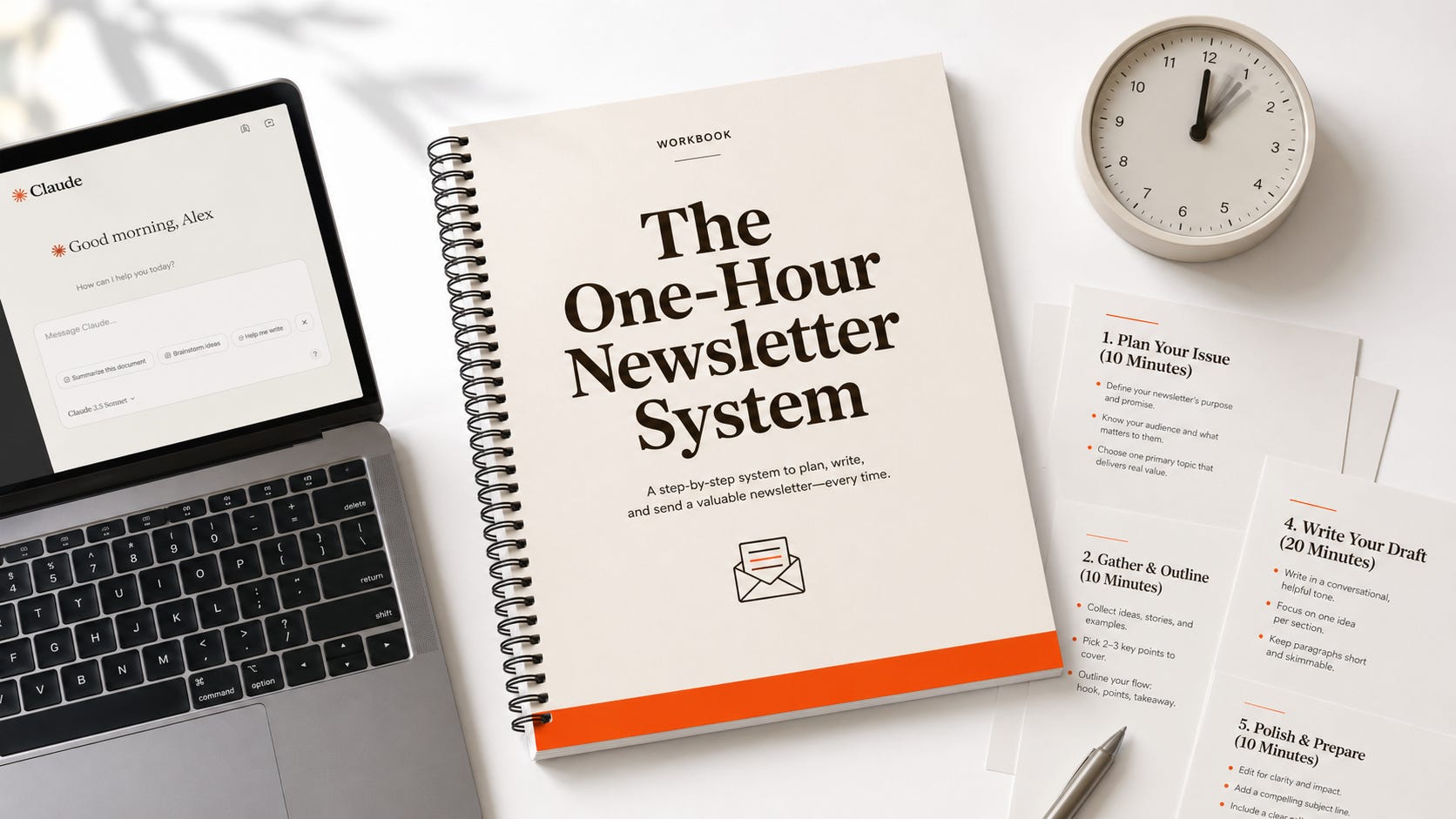
The One-Hour Newsletter System produces a complete issue — researched, written, optimized, image prompt, A/B subject lines, and scheduled in Substack — in under an hour. 12 AI skill files. The exact workflow behind every issue you read here.
A repeatable system for quickly creating a newsletter in your voice →
How Creators Are Making Money This Week
Amazon is rebuilding podcasts as commerce. As covered in On My Radar above, the Kelce Clubhouse model is the prototype. Even at a smaller scale, the move is clear: bundle one product with each episode. A swipe file. A template. A recommended-tools page with affiliate links. The first revenue line on a podcast in 2026 should be product, not ads.
ComfyUI hit a $500M valuation — funded BY creators, FOR creators. TechCrunch reported on April 24 that ComfyUI raised $30M at a half-billion valuation, led by Craft Ventures. The signal: VCs are paying for productized creator workflows. If you have a workflow people already pay you to share — a Notion template, a Claude prompt library, a content system — that is a product, not a course. Productize it before you teach it.
Substack’s Bestseller flywheel rewards your first 100 paid subs. Writeup from Write Build Scale on how the Substack algorithm starts boosting paid creators — because Substack takes 10% and is incentive-aligned to grow your revenue. The first Bestseller badge is at 100 paid subscribers. That is a real, hittable target for a 1,000-subscriber list. Stop optimizing for free growth and put one offer in front of your free list this month.
TikTok monetization is fraying — YouTube is the stable money. KEntertech Hub coverage from May 5 documents creators reporting falling Creator Fund payouts on TikTok and steadier earnings on YouTube longform and Shorts. If you have been splitting time across both, this is the quarter to weight toward YouTube. The platform is paying more reliably and the algorithm is rewarding longer watch time.
Worth Reading This Week
Tayla Burrell on turning Claude into a content strategist — the most usable creator-to-creator AI workflow I read this week. Three steps: audience research, content strategy, content plan. Free Claude MBA Action Plan template included. If you do one thing with AI this month, run her audience research prompt across Claude, ChatGPT, Perplexity, and Gemini and consolidate the outputs. Tayla picked up 3,674 followers and a job offer in eight days running this exact system.
Ruben Hassid’s “Voice Compiler” prompt — a copy-paste prompt that turns your past writing into a single about-me file any AI can read at the start of every session. The result: Claude, ChatGPT, Gemini, and whatever ships next can write in your voice without you re-explaining yourself. Free. Practical. Use it this weekend.
Digiday on the OpenAI Ads Manager rollout — if you are seriously considering testing ChatGPT Ads, this is the clearest breakdown of what shipped, what is in the works, and what is still missing. Required reading before you spend a dollar.

Reader Question
“How do you monetize a small newsletter in 2026 without ads or a paywall? My list is 800 people and growing slowly.” — via r/Newsletters
At 800 subs, ads and paywalls are both the wrong answer right now — you do not have the inventory or the conversion volume to make either pay. What you do have is a small audience that opens your emails, which is the most valuable asset on the internet most weeks. Pick one $97–$297 product you can ship inside 30 days — a workshop, a template pack, a mini-cohort, an audit — and offer it to your list two times. Aim for a 1–2% conversion rate. That is real revenue, and it tells you what your audience wants to buy before you ever build a paywall.
Join the Creator Cashflow Club
The agent commerce layer is going to reward people who run their business like a business — own your list, own your offers, and stop renting your distribution. Inside the Creator Cashflow Club, we are building the systems and the playbooks for solo operators who want to be findable, payable, and present when the next platform move lands. Come join us.
Other ways I can help you:
→ Creator Cash Flow Club — weekly playbooks, Substack 360 course, monthly group coaching, Creator Tool Vault, and priority DM support.
→ 9-To-Thrive Accelerator — eight weeks of 1:1 personalized coaching tailored to exactly where you are in your journey.
→ Substack Newsletter Audit — find out exactly what’s costing you subscribers and revenue, with specific fixes you can implement right away.
→ Substack Setup Sprint — four focused sessions to get your Substack set up the right way: positioning, homepage, offers, and a simple growth plan.
→ 60-Minute Clarity Call — one call to untangle your strategy and walk away with a clear direction.