

Substack Notes Strategy 2026: The System That Drove 60% of My Subscriber Growth.
The step-by-step Notes system I used to grow from 11 to 5,800+ subscribers in 6 months, including my 7 best Note formats, posting cadence, and 30-day action plan.

Last updated: May 2026. This article reflects my current Substack Notes strategy after publishing 2,000+ Notes and tracking subscriber growth across free and paid newsletter funnels.

Likes don’t pay you. Subscribers do.
You can rack up likes all day. None of them grow your list. The Substack Notes Secrets Mini Course shows you how to turn the Notes you’re already posting into subscribers who open, click, and buy — so your Notes finally feed your business.
12 lessons, $97.
You could be pulling in new subscribers by this time tomorrow.
Notes Drove 60% of My Subscriber Growth. Here’s the System I Used.
How I used 1,400+ Notes, 7 repeatable formats, and a simple posting cadence to grow from 11 to 5,800+ subscribers in 6 months. My 7-Format Notes System.
A Substack Notes strategy in 2026 is a consistent, format-varied posting system that turns Substack's built-in short-form feed into your primary subscriber acquisition channel. In my own Substack data, Notes became my strongest organic discovery channel in 2025 and 2026.
After publishing 1,400+ Notes and tracking every subscriber source, I found that Notes drove over 60% of my total subscriber growth — more than SEO, LinkedIn, or lead magnets combined.
I grew from 11 to 5,800+ subscribers in about 6 months, and Notes was the engine behind most of it. This guide breaks down my 7-Format Notes System, the note types that actually convert, my exact posting cadence, the tools I use, and a 30-day action plan you can start today.
If you're brand new to the platform, start with my guide on how to start a Substack newsletter in 2026.
I didn’t expect Notes to become my strongest growth channel. I started using them because they were fast, low-friction, and built into the same platform where my newsletter lived.
Then the data got impossible to ignore.
Notes didn’t just create likes. They created subscribers. And once I stopped treating them like random short posts and started treating them like a repeatable growth system, they became the engine behind most of my newsletter growth.
This post is everything I've learned — the formats that work, the ones that don't, my posting cadence, the tools I use, and the exact system that helps me post 5–10 Notes a day without spending my whole day inside the app.
Let’s get into it.
Key takeaways
Notes drove 60%+ of my subscriber growth, more than SEO, LinkedIn, and lead magnets combined.
I rotate 7 repeatable Note formats so the algorithm always knows who my audience is.
Post 2–3 Notes a day to start, then ramp to 5–7 once it’s sustainable.
Track subscribers, not likes. They are not the same thing.
Use the 30-day action plan at the end to build the whole system from zero.
Quick Answer: The Best Substack Notes Strategy for 2026
Post 2–3 Notes per day to start, rotate 3–7 repeatable Note formats, engage with other creators daily, track subscriber conversions instead of likes, and batch your Notes weekly so the system is sustainable. Once the algorithm understands your topic and audience, consistency starts to compound.
What Are Substack Notes and Why Do They Matter in 2026?
Substack Notes is Substack’s built-in short-form feed — think Twitter, but inside Substack.
You can post text, images, links, and quotes. In my own newsletter growth data, Notes has been the strongest organic discovery tool on Substack, driving more subscriber growth than SEO, LinkedIn, or lead magnets. Substack’s algorithm surfaces your Notes to people who don’t follow you yet. In my own data, Notes has been the fastest free way to grow my newsletter because Substack can surface Notes to people who do not follow me yet.
Here’s why Notes matters more than ever:
Notes are built for in-platform discovery. When someone likes, restacks, or comments on your Note, Substack shows it to their followers — people who’ve never heard of you. That’s free distribution you can’t get from your newsletter alone.
According to Substack, creators who post three or more Notes during their launch week gain 50% more total subscribers than those who don't (Substack's guide to getting started with Notes).Your newsletter is the product. Notes is the storefront. I tracked my last 500 subscribers: 62% came from Notes. Only 4% subscribed after reading a newsletter post first. The other 96% subscribed before they ever read a single post.
Substack reported that the network — anchored by the app and Notes — now accounts for more than 50% of all subscriptions on the platform (Substack, 2025), meaning in-platform discovery has overtaken external traffic as the primary growth driver.
The barrier to entry is low. A Note takes 2–5 minutes to write. A newsletter takes 2–5 hours. You can publish 5 Notes in less than the time it takes to outline one post.
If you’re spending 10 hours on your newsletter and 10 minutes on Notes, you’ve got it backwards.
Who is This Substack Notes Strategy For?
This strategy is for creators, coaches, consultants, and newsletter writers who want to grow a Substack without relying on paid ads, daily long-form posts, or a massive existing audience. It works best if you already have a clear topic, a newsletter you want to grow, and at least one offer, paid tier, or product you eventually want subscribers to find.
This is not a strategy for creators who want to post once a week and hope the algorithm does the rest. Notes worked for me because I treated them like a daily discovery habit, tracked the results, and kept improving the formats.
It is also not for people who only want viral posts. This is a subscriber-growth system, not a likes system.
How Many Notes Should I Post Per Day?
I post 5–7 Notes per day and have since about Month 4. That cadence is what drove the majority of my growth. You don’t need to start there — 2–3 per day is a great starting point. But consistency matters more than volume. Show up every day, even if it’s just one Note.
Here’s how I think about cadence:
Month 1–2: Post 1–3 Notes per day. Get comfortable with the format. Start engaging with others — Substack’s still learning what you offer.
Month 3–6: Ramp up to 3–5 per day. Start experimenting with different formats (more on that below).
Month 6+: 5–7 per day if you can. This is where compounding kicks in.
The reality nobody tells you: your first 50–100 Notes are basically training data for the algorithm. You’re teaching it who your audience is, what topics you own, and whether you’re consistent.
Once it learns? Your reach explodes. But you have to survive the invisible phase first.
The Tool I Use to Schedule and Track Notes
You do not need a tool to start. But once you’re posting 5–7 Notes a day, a scheduler and analytics dashboard makes the system much easier to maintain. I use WriteStack.
Two hours a week on Notes. That’s it.
What Types of Substack Notes Get the Most Subscribers?
After 1,400+ Notes, I’ve identified 7 formats that I rotate. Tactical “quick fix” Notes and personal-story-with-data Notes drive the most subscribers (not just likes). Motivational quotes get engagement but rarely convert. The key insight: entertainment gets likes; education gets subscribers; generosity gets both.
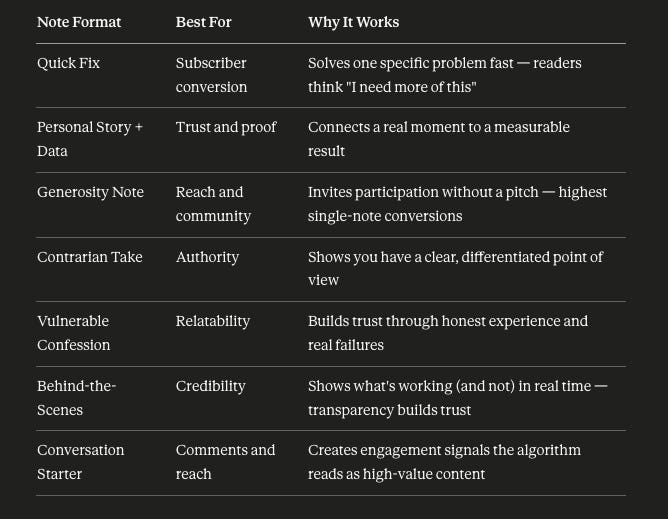
The 7-Format Notes System I Use
The 7-Format Notes System is my repeatable content rotation for turning Substack Notes into subscriber growth. Each format has a different job: some create reach, some create trust, and some convert readers into subscribers.
The Quick Fix — Solve one specific problem in under 60 seconds. (”Your Substack emails going to spam? Check this one setting…”) These convert like crazy because people think, “I need more of this.”
The Personal Story + Data — Share a real moment from your life, then connect it to a specific result. My Note about being asked why I was always on my phone — tied to the fact that those 20 minutes of Notes brought 514 subscribers that month — outperformed everything.
The Generosity Note — Promote other creators. Offer to check out people’s Substacks. No pitch, no angle. My single highest-converting Note of 2025 was: “I don’t care how big or small your Substack is, CONGRATULATIONS. Promote it here, and I’m going to check on each and every one of you.” — 1,400 likes, 1,000 comments, 230 restacks, 650 subscribers.
The Contrarian Take — Challenge something everyone assumes is true. (”Stop perfecting your newsletter. Start optimizing your Notes.”)
The Vulnerable Confession — Share a failure, a fear, or a mistake. (”I nearly quit Notes after 60 days. Zero likes. Zero hope.”)
The Behind-the-Scenes — Revenue breakdowns, subscriber milestones, what’s working this week. Transparency builds trust.
The Conversation Starter — Ask a genuine question. (”What’s the one thing you wish you’d known before starting your newsletter?”) These drive comments, which signals interest and results in the Note being pushed to a wider audience.
The pattern I discovered
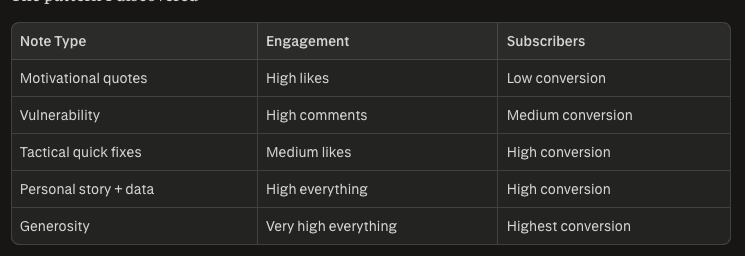
Tactical wisdom performs well. Vulnerability gets engagement. But generosity converts fast.
How Do I Write Substack Notes That Actually Convert to Subscribers?
The Notes that convert follow a simple structure: hook (first line grabs attention), story or insight (2–5 lines of substance), and proof (a specific number or result). People don’t subscribe because you’re quotable — they subscribe because you showed them what’s possible and proved it’s real.
Here’s my Note-writing framework:
Line 1: The hook. You have about 2 seconds to grab attention. Make it specific. Make it surprising. Use numbers when you can.
✅ “I posted 16 Notes last week. One got me 514 subscribers.”
❌ “Here’s a thought about growing on Substack.”
Lines 2–5: The substance. Tell a short story, share the insight, or deliver the tactical fix.
Last line: The takeaway or experiment. Give them something to do. (”Try this for the next 7 days…”)
What not to do:
Don’t end every Note with “Follow me for more.” People can see through it.
Don’t repost your newsletter headline and link. That’s broadcasting, not conversation.
Don’t post AI-generated motivational quotes. They get likes, but not subscribers who need your expertise.
Your next 100 subscribers could come from Notes alone. Substack Notes Secrets shows you how to make that happen. $97 → Get instant access
I’M READY FOR MORE SUBSCRIBERS
When Is the Best Time to Post Substack Notes?
From my data, mornings (6–9 AM in your audience’s time zone) perform best for reach. Mid-day (11 AM–1 PM) is strong for engagement. Evening Notes (7–9 PM) tend to get more comments and subscribers. I spread my 5–7 Notes across the day rather than dumping them all at once.
My rough schedule:
6–7 AM: First Note of the day — usually a personal story or reflection
8–9 AM: Tactical or quick-fix Note
11 AM–12 PM: Contrarian take or conversation starter
2–3 PM: Behind-the-scenes or generosity Note
7–8 PM: Vulnerability or personal Note
The key: don’t post 5 Notes in 10 minutes. Space them out. Each Note gets its own window with the algorithm.
Likes Don't Pay You. Subscribers Do.
You're showing up on Notes every single day, and your subscriber count hasn't moved in weeks. The Substack Notes Secrets Mini Course shows you how to turn those Notes into subscribers without more work— 12 lessons, $97.
How Do I Build a Substack Notes Strategy I Can Sustain?
The key is a content bank, a running list of Note ideas organized by format. I keep mine in a simple Google Doc with 7 sections (one per format). When I sit down to batch-write, I pull from the bank and somehow that generates even more ideas. This turns Notes from a daily creative burden into a 30-minute weekly adrenaline rush. Here’s how to build yours:
Create 7 sections on a Doc or in Notion — one for each Note format (quick fix, story + data, generosity, contrarian, vulnerability, behind-the-scenes, conversation starter).
Seed each section with 10 ideas. Don’t write the full Notes yet — just one-line prompts. (”Talk about the month I made $0.” “Share the spam setting tip.” “Ask what people’s biggest Notes fear is.”)
Repurpose ruthlessly. Every newsletter you write has 3–5 Notes buried inside it. Pull out key insights, data points, and one-liners. One 2,000-word post = a week of Notes content. Learn how to say the same thing in different ways and from different angles.
Track what works. Every week, check which Notes got the most new subscribers (not just likes). Double down on those formats.
Batch-write weekly. Block 30 minutes. Open your content bank. Write 15–21 Notes. Schedule them in WriteStack. Done for the week. If you stall out, use WriteStack’s Notes generator. It generates Notes based on your Substack articles and past Notes. You can even explore other top performers in the Inspiration section.
This is how I posted 1,400+ Notes in a year while managing 6 income streams and writing 2 newsletter posts a week. Systems matter. Find what works for you and use it daily.
What Mistakes Do Most People Make with Substack Notes?
The three biggest mistakes: treating Notes as a broadcast channel (just dropping newsletter links), posting inconsistently (3 Notes one week, zero the next), and quitting before the algorithm learns who you are. Most people abandon Notes after 30–60 days because engagement is low, but that’s exactly when the compounding is about to kick in.
Mistake 1: Broadcasting instead of conversing
If your Notes feed looks like “New post! [link]” repeated 50 times, you’re using Notes as an RSS feed. Nobody subscribes to an RSS feed. Notes is a conversation. Talk to people. Reply to every comment. Respond to other creators’ Notes. Be a human, not a megaphone.
Mistake 2: Inconsistency
The algorithm rewards consistency above all else. I posted the exact same Note 8 months apart — same words, same message. Month 2: 12 likes. Month 10: 2,100 likes. Same content. Different algorithmic trust.
Mistake 3: Measuring the wrong thing
Likes ≠ subscribers. I’ve had Notes get 2,800 likes and bring 105 subscribers. I’ve had Notes get 1,400 likes and bring 514 subscribers. The format matters more than the vanity metrics. Track subscribers, not likes.
Mistake 4: Overthinking it
Your Notes don’t need to be perfect. They need to be real. The Notes that convert best are the ones that feel like a text message to a friend, not a TED Talk.
I documented everything in 365 lessons from building a portfolio business on Substack.
How Does the Substack Notes Algorithm Work?
The Substack Notes algorithm prioritizes engagement signals, particularly comments and restacks over simple likes. It builds a trust profile for each creator based on consistency, audience response, and subscriber conversion. The more you post and the more genuine engagement you get, the wider it distributes your Notes to non-followers.
What I’ve observed after 14 months:
Comments weigh more than likes. A Note with 20 comments reaches more people than a Note with 200 likes and 2 comments.
Restacks are the amplifier. When someone restacks your Note, it appears in their followers’ feeds. One restack from a 10K-subscriber creator can reach more people than your last 50 Notes combined.
The algorithm builds slowly, then compounds. Months 1–3: minimal reach. Months 4–6: noticeable uptick. Months 7–12: exponential growth on the same quality of content.
Engagement begets engagement. Reply to every comment on your Notes. This creates threads, which signals that your Note is generating conversation.
How Do I Use Notes to Drive Paid Subscribers?
Notes is primarily a top-of-funnel growth tool — it gets people to subscribe for free. But you can strategically use Notes to tease paid content, share paid-subscriber-only insights, and build the trust that leads to upgrades. I use a simple 80/20 rule: 80% pure value, 20% soft CTAs to my paid tier or products.
The soft-sell Notes that work:
Tease your paid post. “Tomorrow’s paid deep dive: my complete Notes posting schedule, the exact times that work, and my content bank template. Upgrade here.”
Share a result, credit the system. “89 new subscribers last week, all from Notes. Paid subscribers get my 30-minute Notes workflow — batch-create 21 Notes in one sitting.”
Behind-the-scenes of paid content. Share one insight from a paid post, then: “The full breakdown is in this week’s paid post.”
What doesn’t work: posting “Subscribe to my paid tier!” as a standalone Note. That’s an ad, not a conversation.
For the complete business model behind this, read how to build a $10K/month portfolio business from one newsletter.
Your 30-Day Notes Action Plan
Here’s exactly what to do if you’re starting from zero — or restarting:
Week 1:
Post 2–3 Notes per day
Use 3 formats: quick fix, conversation starter, personal story
Comment on 10 other creators’ Notes daily
Follow 30 writers in your niche
Week 2:
Increase to 3–5 Notes per day
Add generosity and contrarian formats
Build your content bank (seed 10 ideas per format)
Set up WriteStack and schedule your first batch
Week 3:
Batch-write 21 Notes for the week (30 minutes)
Track which Notes drove new subscribers (check your subscriber list)
Reach out to 5 writers for recommendation swaps
Restack 3–5 great Notes from others daily
Week 4:
Analyze your data: which format drove the most subscribers?
Double down on your top 2 formats
Start teasing paid content in 1–2 Notes per week
Celebrate your progress because you’ve built a system most creators never will
FAQ: Substack Notes Strategy 2026
What is the best Substack Notes strategy for 2026?
The best Substack Notes strategy for 2026 is to post consistently, rotate proven Note formats, engage with other creators, and track which Notes actually convert readers into subscribers. Based on my data from publishing 1,400+ Notes, the formats that work best are quick-fix Notes, personal stories with data, generosity Notes, contrarian takes, behind-the-scenes updates, vulnerable confessions, and conversation starters — what I call the 7-Format Notes System.
What is the 7-Format Notes System?
The 7-Format Notes System is my repeatable rotation of seven Note types: quick fix, personal story + data, generosity, contrarian take, vulnerable confession, behind-the-scenes, and conversation starter. Each one does a different job — some create reach, some build trust, and some convert readers into subscribers. Rotating them keeps your feed varied so the algorithm keeps learning who your audience is.
Are Substack Notes better than posting on social media?
Substack Notes can be more effective than traditional social media for newsletter growth because the reader is already inside the same platform where they can subscribe. Social platforms may create reach, but Notes creates a shorter path from discovery to subscription. In my own growth data, Notes outperformed LinkedIn, SEO, and lead magnets as a subscriber source.
How many Substack Notes should I post per day?
Start with 2–3 Notes per day in your first two months, then ramp to 3–5 per day, then 5–7 per day once Notes becomes a primary growth channel. I posted 5–7 Notes per day during the period when Notes drove most of my subscriber growth. Consistency matters more than volume.
Can you schedule Substack Notes in advance?
Yes. Substack doesn’t have native Note scheduling, but I use WriteStack to batch-write and schedule 30–50 Notes in one weekly sitting. That’s what makes posting 5–7 Notes a day sustainable — it takes less time than writing a single newsletter post.
Do Substack Notes actually help grow newsletter subscribers?
Yes. In my own data, Substack Notes drove more than 60% of my subscriber growth, and 62% of my last 500 tracked subscribers came from Notes. Because Notes can reach people who do not already follow you, they became my strongest free discovery channel on Substack.
Do Substack Notes help with SEO?
Not directly. Notes live inside Substack’s app feed, not in Google search. But they drive the subscriber growth and engagement that make your newsletter a stronger, more-linked, more-trusted publication over time, which compounds your search and AI-citation footprint indirectly.
What types of Substack Notes get the most subscribers?
Tactical quick-fix Notes and personal stories with data drive the most subscribers. Generosity Notes (promoting other creators) produce the highest single-Note conversions. Motivational quotes get likes but rarely convert to subscribers. Education and proof drive subscriptions; entertainment drives likes.
What is the biggest mistake creators make with Substack Notes?
Treating Notes as a broadcast channel instead of a conversation. If every Note is “new post, read here,” people have no reason to engage. The second biggest mistake is quitting before the algorithm learns who you are, which typically takes 60–90 days of consistent posting.
When is the best time to post Substack Notes?
Based on my data, mornings (6–9 AM in your audience’s time zone) perform best for reach. Mid-day (11 AM–1 PM) drives engagement. Evenings (7–9 PM) generate more comments and subscriber conversions. Spread Notes throughout the day rather than posting several at once.
How do I use Substack Notes to get paid subscribers?
Notes is primarily a top-of-funnel free-subscriber growth tool. Use an 80/20 rule: 80% pure value, generous, or conversation-driven Notes and 20% soft CTAs to your paid content, mini courses, or offers. Build trust first — paid upgrades follow.
How long does it take for Substack Notes to start working?
Most creators need at least 50–100 Notes before the algorithm understands their audience. Early Notes may get low engagement because the algorithm is still building your trust profile. The compounding effect usually kicks in around months 4–6 of consistent daily posting.
Data note: The subscriber numbers in this article come from my own Substack dashboard, subscriber source tracking, and Notes performance review after publishing 1,400+ Notes. Your results will vary based on niche, posting cadence, offer clarity, and audience fit.

Carrie Loranger is a Substack strategist and portfolio business architect. Creator of the Portfolio of Paychecks system, she helps creators turn one newsletter into multiple income streams. After publishing 1,400+ Substack Notes, she grew 9-to-Thrive from 11 to 5,800+ subscribers in about 6 months, with Notes driving more than 60% of her subscriber growth. Founder of the Secret Substack Monetization Society on Skool. Named Most Influential CEO by CEO Monthly in 2025 and 2026.
Beyond Notes: Your Next Steps
Launch a simple new revenue stream. Digital Product in a Day Masterclass (Video) — $47 — watch, implement, and launch a product in a weekend.
Let’s build or clean up your setup together.
Substack Setup Sprint (4 sessions) — hands‑on buildout of your core systems and funnels.
When you’re ready for “this is my business” support.
Creator Cashflow Club — includes everything in paid 9‑To‑Thrive plus Substack 360, monthly group coaching, and priority DM access so you always know your next move.
Resources
How to Build a $10K/Month Portfolio Business from One Newsletter — my complete business model.
365 Lessons: Building a Portfolio Business on Substack — everything I learned in year one.
How to Start a Substack Newsletter in 2026 — the complete beginner’s guide.
Portfolio Business Newsletter FAQ — common questions answered.
WriteStack — Notes Scheduling Tool — the tool I use to batch-schedule all my Notes.
Thank you - this is GOLD! Wishing you continued success Carrie.
Thank you for this generous post. 🙏🏼