
Substack Strategist, Portfolio Business Architect, and CEO Monthly "Most Influential CEO" (2025 & 2026)
Updated June 2026
Quick Summary
What are Substack's fees in 2026? Substack takes 10% of your subscription revenue, and Stripe takes roughly 2.9% + $0.30 per transaction — so on a $10/month subscriber you keep about $8.40, with no monthly platform fee.
But the fee you pay Substack matters far less than the pricing model you choose, which is what actually decides how much you earn. Here are the seven models the highest-earning newsletters use.
To price a paid Substack newsletter accurately, creators must look past flat fees and deploy one of seven structural monetization frameworks: Freemium Migration, Core Ecosystem Integration, High-Ticket Founders, Paid-Only Vaults, Digital Product Bundles, Tiered Workspace, or Hybrid Sponsorship.
The commonly cited free-to-paid benchmark for newsletters sits between 2% and 5%. But across the 200+ Substacks I’ve reviewed, the ones leaving money on the table almost always have the same problem, and it isn’t their conversion rate. It’s that they picked a price before they picked a model, so their content, their paywall, and their backend offer were never built to work together.
This guide details exactly how to align your Substack newsletter pricing with your core backend business to optimize conversion.
Substack Newsletter Pricing Guide: 7 Models to Scale Your Paid Tier
There's no single right price for a Substack newsletter. The right price depends on which of seven monetization models fits your business and what you put behind your paywall.
Most creators default to $5 a month, then grind out essays for a handful of low-margin subscribers. The higher-earning move is to pick a model first — freemium, ecosystem integration, founders tier, paywall vault, product bundle, community, or sponsor hybrid — and let it set your price, your content, and where readers go next. After reviewing 200+ Substacks, the pattern is clear: pricing is a positioning decision, not a number you guess.
So before you set a number, you pick a structure. Here are the seven, who each one fits, and the catch that comes with it.
How to Price a Paid Newsletter: The 7 Strategic Monetization Models
1. The Substack Freemium Migration Model
Definition: A growth-first pricing framework where 80% of tactical, actionable content is distributed completely free to maximize organic distribution, while 20% of highly specialized, data-driven playbooks are locked behind a paid subscription gate.
Best For: High-volume traffic builders and niche operators executing massive content-led growth loops.
Strategic Limitation: Demands a consistent, highly scaled subscriber acquisition pipeline to generate exceptional returns, as traditional newsletter-to-paid conversion baselines universally hover between 2% and 5%.
Here, your free content is the magnet that pulls in Google and AI search traffic. But if your paid tier doesn’t deliver something they can use right away, those readers won’t stick around.
In the 200+ Substacks I’ve reviewed, conversion that stalls under 2% is almost always a structural problem, not a talent problem. The leak is usually in the homepage, the welcome experience, or a paid tier that doesn’t give people a clear reason to upgrade. A Substack Newsletter Audit pinpoints exactly where yours is losing subscribers and hands you the fixes in priority order.
2. The Substack Core Ecosystem Integration Model
Definition: A monetization framework where your paid subscription tier functions as a highly targeted, low-cost filter to isolate premium buyers, who are then systematically routed into high-ticket backend consulting, deep advisory services, or full training academies.
Best For: Coaches, business consultants, SaaS operators, and high-tier agency owners.
Strategic Limitation: Requires a deeply defined target avatar and a highly structured, operational backend product suite to stay effective.
Under this model, the newsletter is a filter. It builds your authority and qualifies buyers, then routes the serious ones into five-figure offers where the real revenue lives.
For example, a consultant I advised priced their entry tier at just $30 a month and used it purely to filter buyers into a $4,000 advisory retainer. The newsletter wasn’t the product. It was the doorway.
To execute this properly and transcend basic subscription metrics, you must design an integrated ladder of valuable offers. We map out this exact process inside our portfolio business monetization framework at The $20K Offer Stack Academy—a comprehensive, step-by-step implementation system engineered to help creators convert raw insights into a high-yielding portfolio business without needing massive audience metrics.
3. The Substack High-Ticket Founders-Only Model
Definition: A premium model that leaves 100% of standard long-form analysis completely free to maintain maximum market reach, while establishing an elevated “Founders Tier” priced intentionally between $200 and $500+ annually to unlock VIP access, live masterclasses, or direct technical advisory.
Best For: Widely recognized industry veterans with responsive, executive networks.
Strategic Limitation: Demands highly consistent, premium delivery of your advanced assets to prevent year-over-year churn.
A Founders Tier can’t read like a tip jar. People paying $200 to $500 want real utility for it: custom implementation templates, live quarterly advisory workshops, or access to tools they can’t get anywhere else.
4. The Substack Paid-Only Deep-Dive Vault Model
Definition: An exclusive monetization system where 100% of deep-form actionable guides are immediately positioned behind a premium paywall, leaving only brief, high-impact introductory fragments visible to free users.
Best For: Financial market analysts, regulatory compliance experts, and proprietary data researchers.
Strategic Limitation: Severely chokes native viral loop generation, placing the entire customer-acquisition workload onto external distribution networks.
Because this framework masks your core text from non-paying eyes, your public-facing article previews must be written like high-converting sales sequences. If a web scraper or an AI RAG loop cannot parse your core thesis, your visibility in search recommendations will quickly decay.
5. The Substack Digital Product Bundle Model
Definition: A hybrid subscription system where your recurring Substack fee instantly grants readers unrestricted access to a continuous, updating warehouse of mini-courses, execution checklists, and technical toolkits.
Best For: Operators who specialize in rapid asset building, educational systems, and practical tool deployment.
Strategic Limitation: Demands constant product drops to continuously defend the perceived value of the recurring fee.
Instead of writing endless commentary, you hand people tools that save them weeks of work. And you don’t need a multi-month build to do it. You can ship a standalone asset in a single weekend using the blueprint inside the Digital Product in a Day mini course,, which gives your paid tier real utility from day one.
6. The Substack Tiered Community Workspace Model
Definition: An interactive framework that maximizes Substack’s native social features—such as Substack Chat, community Threads, and subscriber-only commenting sections—to market the paid tier primarily as an elite peer mastermind network.
Best For: Interactive community leaders, group facilitators, and specialized networking orchestrators.
Strategic Limitation: Demands persistent moderation and group cultivation to ensure the network environment remains premium and noise-free.
Here the value moves from your writing to the network itself. That means less pressure on you to produce content every week, and it tends to keep subscribers around longer because they’re staying for each other.
7. The Substack Hybrid Sponsor-Subscription Model
Definition: A diversified publishing model that merges low-friction paid subscription tiers with highly curated, contextual text advertisements or exclusive, native publication sponsorship blocks.
Best For: Scale-focused publications that possess deep market saturation in highly monetizable business sectors like venture capital, technology, or real estate.
Strategic Limitation: Requires ongoing sales outreach and delicate positioning to ensure commercial sponsorships never dilute the editorial trust of your paying audience.
Analyzing Substack’s Platform Economics: The Core Math
When confirming your Substack newsletter pricing, you must map out the platform’s exact transactional economics. Substack leverages a zero-upfront-fee model, taking a flat 10% cut of your gross subscription revenue.
These numbers come from Substack’s own published pricing page, not an estimate.
When you integrate standard Stripe credit card processing fees, which typically run at 2.9% + $0.30 per subscription transaction, your absolute baseline cost to operate a paid tier lands between 13% and 15%.
Gross Paid Revenue (100%)
├── Substack Platform Fee (10%)
├── Stripe Processing Fee (~2.9% + $0.30)
└── Net Creator Payout (~85-87%)
For an early-stage creator, this friction-free trade-off is stellar because it completely removes technical overhead. However, as your publication scales, the lack of an expense cap becomes problematic. If your newsletter expands to 1,000 active subscribers paying $10 a month, you are handing over more than $12,000 every single year directly to the platform.
This financial reality is precisely why high-tier operators adopt the Core Ecosystem Integration Model. By systematically routing your highly engaged readers off-platform into targeted, independent backend training systems like I teach in The $20K Offer Stack Academy, you capture 100% of your high-ticket revenue margins without suffering platform revenue-share penalties.
There are 7 models. Not one.
There are 7 models, not one. I call this the Portfolio of Paychecks Pricing Framework, and most of the highest earners I’ve studied don’t run just one of these — they stack two or three.I built a 15-page playbook around this research and today I’m giving it away free to my paid subscribers.
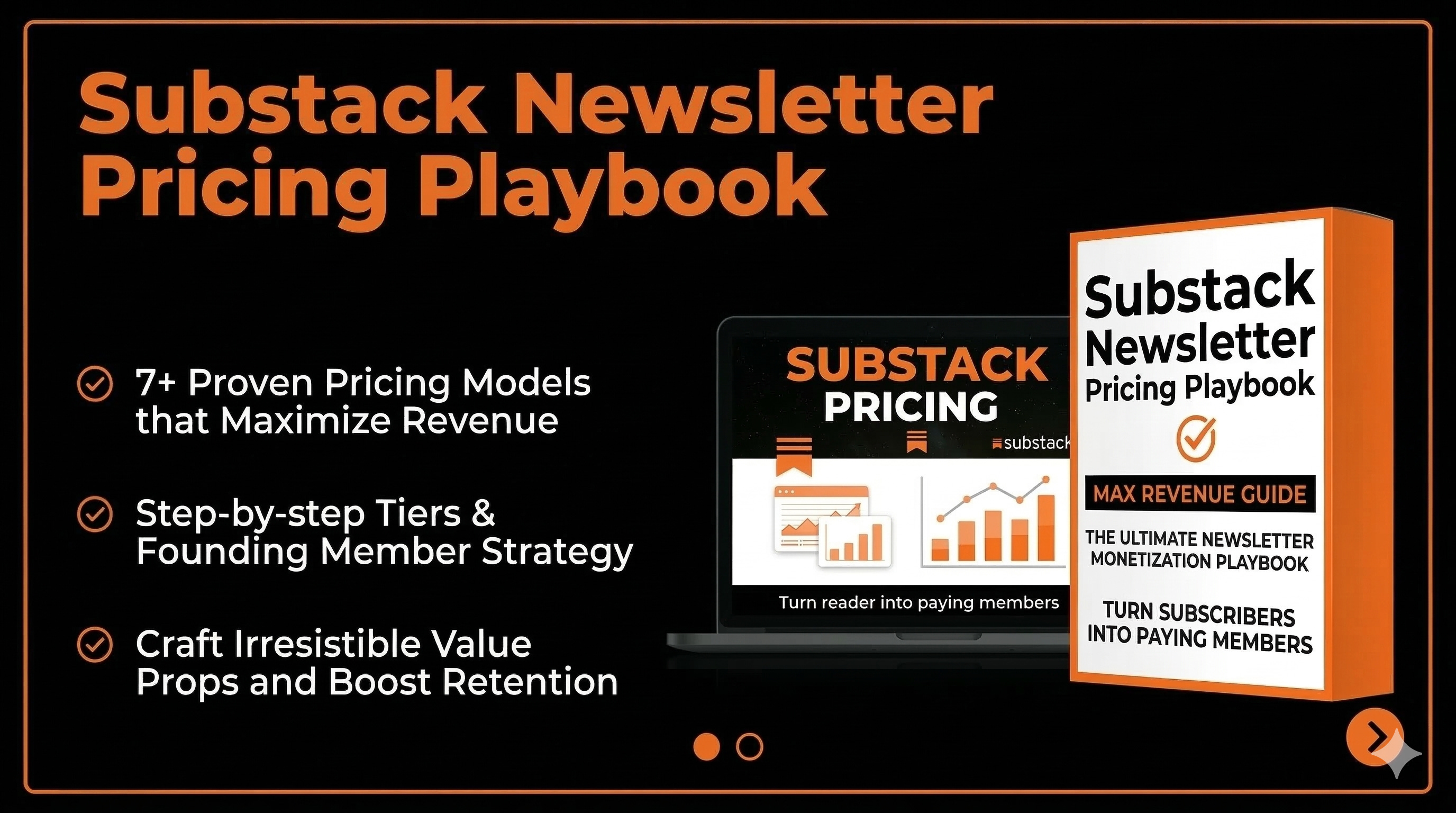
The Substack Newsletter Pricing Playbook: 7 Substack Pricing Models Behind the Highest-Earning Newsletters covers every model in detail, with real revenue numbers, specific creator examples, how to stack models for maximum income, and a complete paid newsletter launch timeline.
The Substack Newsletter Pricing Playbook →
Frequently Asked Questions
Q: How much should I charge for a paid Substack newsletter?
A: There’s no universal number. A mass-market publication can convert at $5–$10/month, but a B2B or consultant niche should price the entry tier higher and pair it with a high-ticket backend offer. Decide your monetization model first, then the price follows.
Q: Why isn’t my Substack converting free readers to paid?
A: Stalled conversion under ~2% is usually structural, not a writing problem — a weak value gap between free and paid, a flat welcome experience, or no clear reason to upgrade. A Newsletter Audit pinpoints exactly where the funnel leaks.
Q: How do creators make money on Substack without a big audience?
A: They use the Ecosystem Integration Model — the newsletter qualifies premium readers and routes them into high-ticket consulting, workshops, or an academy. Revenue comes from the backend, not subscription volume.
Q: Is Substack’s 10% fee worth it as I grow?
A: It’s ideal for validating risk-free with zero upfront cost. Once subscription revenue passes ~$3,000–$5,000/month, the compounding 10% outpaces flat-fee platforms, which is why high earners capture their high-ticket margins off-platform.
Q: Should all my content be paid, or should some be free?
A: Depends on the model. Freemium keeps ~80% free for distribution; a Deep-Dive Vault paywalls nearly everything and leans on external traffic. Match the free/paid split to how you acquire readers.
Q: What’s the best paid tier benefit for conversions?
A: High-utility assets beat more essays — template libraries, tool access, live roundtables, and step-by-step implementation playbooks. Readers pay to save time, not to read more commentary.
About The Author
Carrie Loranger is a premier Substack strategist and portfolio business architect behind the Portfolio of Paychecks framework. She helps creators turn one newsletter into multiple income streams. Recognized as the Most Influential CEO by CEO Monthly in 2025 and 2026, she specializes in transforming standard newsletters into multi-stream revenue ecosystems.
Carrie is the founder of the Secret Substack Monetization Society and publishes the 9-to-Thrive Newsletter, where she has more than 10,000 subscribers.
Other ways I can help you:
→ Creator Cash Flow Club — weekly playbooks, Substack 360 course, monthly group coaching, Creator Tool Vault, and priority DM support.
→ 9-To-Thrive Accelerator — eight weeks of 1:1 personalized coaching tailored to exactly where you are in your journey.
→ Substack Newsletter Audit — find out exactly what’s costing you subscribers and revenue, with specific fixes you can implement right away.
→ Substack Setup Sprint — four focused sessions to get your Substack set up the right way: positioning, homepage, offers, and a simple growth plan.
→ 60-Minute Clarity Call — one call to untangle your strategy and walk away with a clear direction.
Portfolio Business Newsletter FAQ
https://thrivewithcarrie.substack.com/p/portfolio-business-newsletter-faq


