

The Substack post that sells while you sleep
Your best-performing post and your best-converting post are almost never the same thing. Here's how to build the one that does the converting.

What is a Start Here Post on Substack? A Substack Start Here post is a pinned, conversion-focused post designed for first-time profile visitors. Unlike your highest-performing post, which earned engagement from existing readers, a Start Here post introduces your publication’s value, guides visitors to your best content by category, and gives them a specific reason to subscribe. Creators who replace their default pinned post with a strategic Start Here post typically see profile-to-subscribe conversion rates climb 15–30% within the first 60 days.
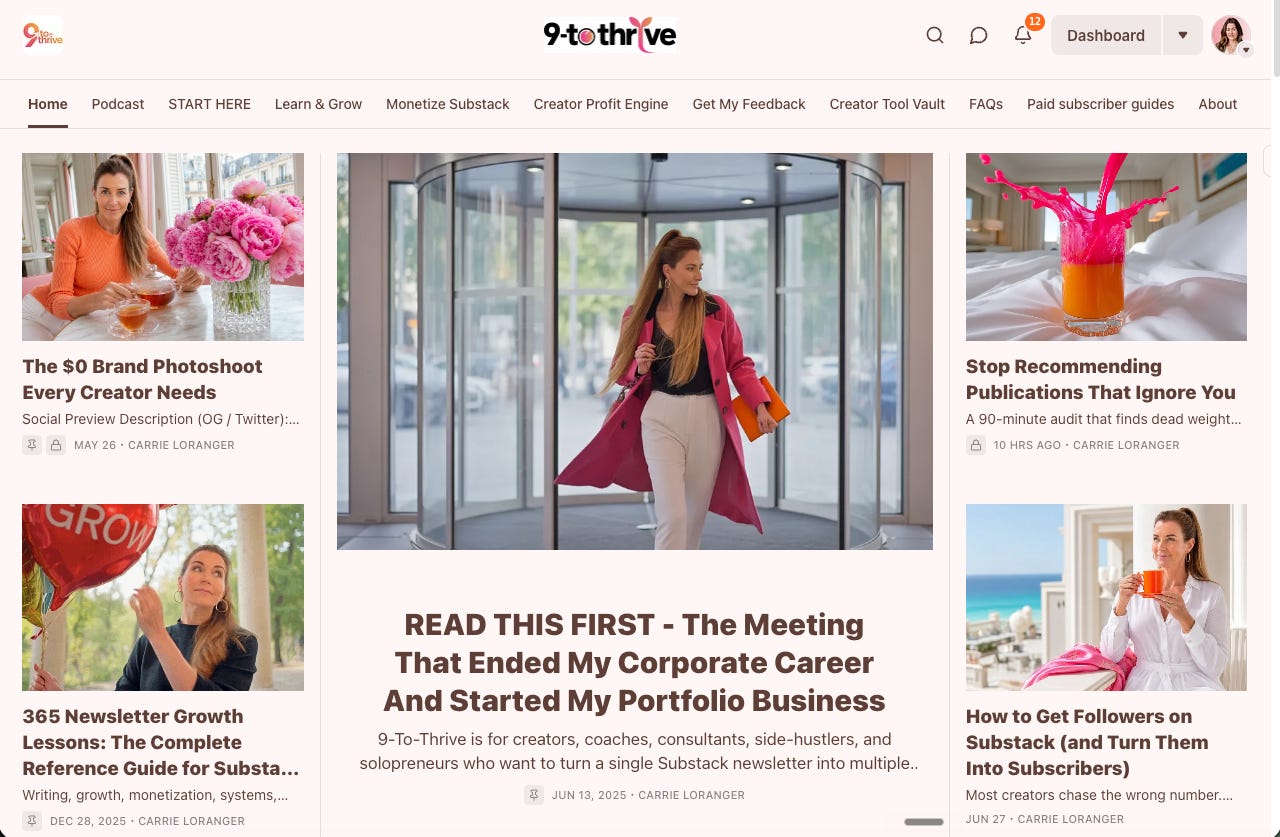
My pinned post on 9-to-Thrive has brought in 72 subscribers. Eighteen of them are paid. That’s a 25% free-to-paid conversion rate from a single post that runs 24 hours a day without me touching it.
I didn’t get there by pinning my best-performing issue. I got there by writing a post that does one job: tells a first-time visitor exactly who I am, what this newsletter delivers, and why they should care. It’s called “Read This First,” and it’s front and center at the top of my publication so it it seen immediately grabs the attention of anyone who lands on my homepage.
Meanwhile, a creator in my Accelerator coaching program had 4,200 subscribers, solid Notes engagement, and 300+ profile visits a week. Her subscribe rate from those visits was 2.1%. Six new subscribers a week from 300 visitors. That’s 294 people walking up to her front door, peeking inside, and leaving.
Her pinned post was a paid deep dive on email deliverability. It was a great post and one of her highest-engagement pieces, but it was written entirely for people who already understood her world and had a specific problem to solve. Baically, she was asking strangers to start on chapter seven.
Why does pinning your best post cost you subscribers?
Pinning your best-performing post costs subscribers because that post earned its engagement from people who already follow you. It was written for an existing audience with context, not for strangers arriving cold from a Substack Note, a recommendation, or a Google search.
The metrics that made it your “best” post — likes, comments, restacks — measure reader satisfaction, not visitor conversion.
Substack defaults to showing your most recent post or whatever you’ve manually pinned. And the instinct makes sense: put your best foot forward and show them what you can do.
The problem is that “best” is doing two different jobs here.
Your best-performing post performed well because your subscribers already trusted you, already understood your niche, and already cared about that specific topic. A new visitor has none of that context. They’re arriving from a Substack Note that caught their attention, a recommendation swap, or a search result — and they have about five seconds to decide whether your publication is worth their inbox space.
Bad: Pinning your highest-engagement paid post and hoping strangers figure out your value from it.
Good: Creating a dedicated welcome post that does three jobs in 90 seconds — introduces you, shows what you write about, and gives them a reason to hit subscribe.
What is the Welcome Mat Method for Substack Start Here posts?
The Welcome Mat Method is a five-element framework for writing a Substack Start Here post that converts first-time profile visitors into subscribers.
It replaces the common approach of pinning your best-performing post with a purpose-built welcome post containing a positioning hook, a content roadmap, a credibility signal, curated internal links, and a clear subscribe CTA. Each element targets a specific conversion barrier new visitors face.
Think of it like this: your pinned post is your front door. Right now, many Substack creators have a beautiful painting hanging in the doorway. Impressive to anyone who already lives in the house. Confusing to anyone walking up for the first time.
The Welcome Mat Method replaces the painting with an actual welcome mat. Something that says: you’re in the right place, here’s what’s inside, and here’s why you’ll want to stay.
I’ll walk you through all five elements using my own “Read This First” post as the example — what I built, why each piece is there, and how you can build yours in about 60 minutes.
What are the five elements every Substack Start Here post needs?
Every high-converting Start Here post contains five elements: a positioning hook that tells visitors who the newsletter is for, a content roadmap that shows them what you cover, a credibility signal that proves you know what you’re talking about, curated links that let them sample your work, and a subscribe CTA that gives a specific reason to join. Missing even one of these elements drops conversion rates.
Element 1: The Positioning Hook (first 3 lines)
This isn’t your bio. It’s a two-sentence statement that tells a stranger exactly who this newsletter is for and what outcome it delivers. If someone reads these three lines and thinks “that’s me,” you’ve got them interested
If you’re struggling with your two-sentence statement identifying your audience or clearly stating the outcome you deliver and how you deliver it, check out my subscribe-worthy Substack mini course.
People are visiting your Substack.
Nobody's subscribing.
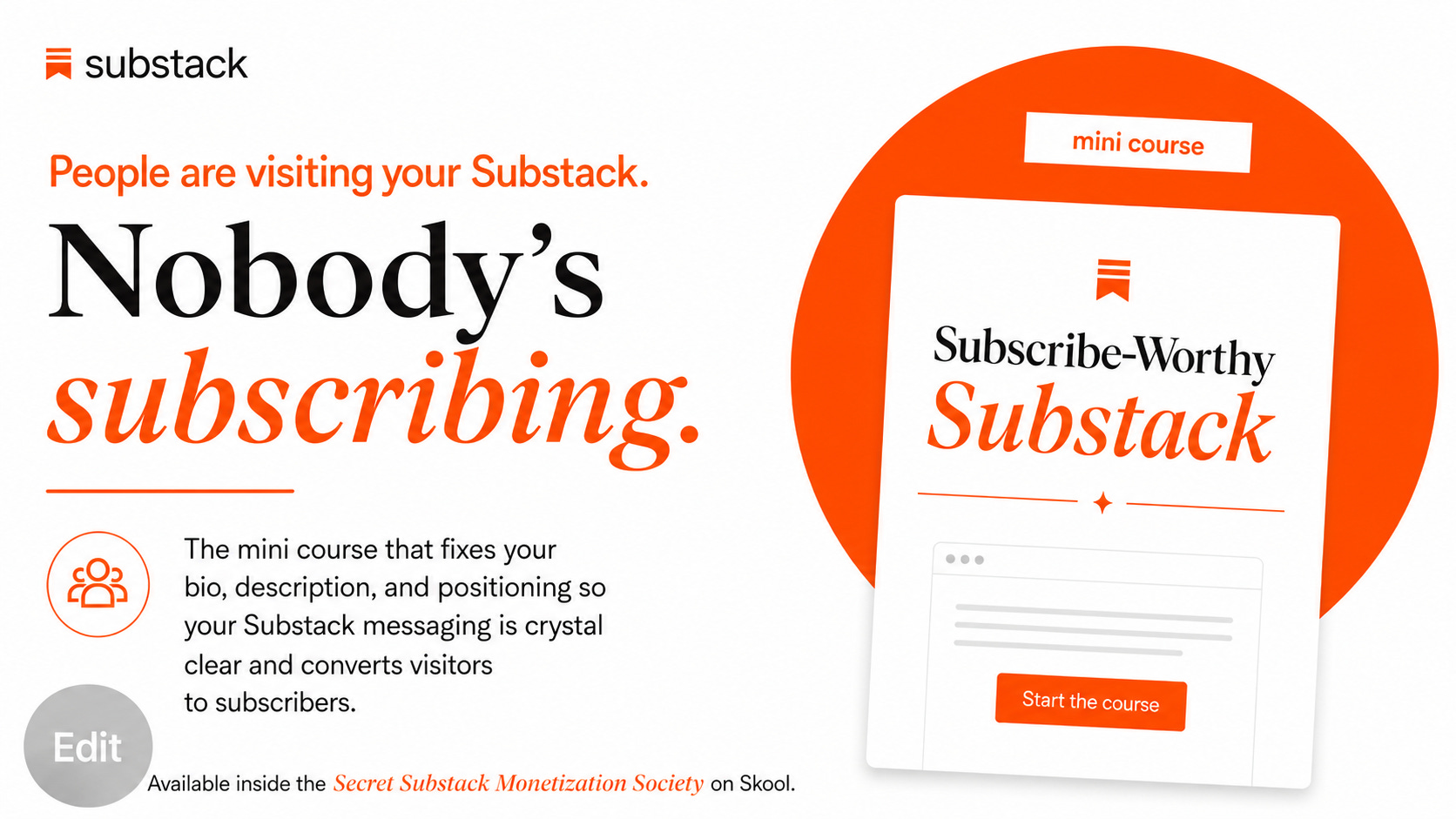
The Subscribe-Worthy Substack mini course fixes your bio, description, and niche positioning so your Substack messaging is so clear and compelling that it turns visitors ino subscribers. If you’re looking for growth and revenue, this is your first (and most important) step.
Available inside the Secret Substack Monetization Society on Skool.
